When it comes to factoring, speed is everything. The faster you can process invoices, collect payments, and reconcile accounts, the healthier your cash flow—and your client relationships—become.
But there’s one process that often lags behind the rest of your operations: cash application.
For many factoring companies, applying incoming payments to the right invoices still means manual data entry and long hours spent cross-referencing remittance details. It’s tedious work that slows down everything from funding availability to reporting accuracy.
But automating cash application changes that dynamic. By turning manual matching into a streamlined, rules-driven process, factoring teams can speed up cash flow, reduce errors, and get real-time visibility into every payment.
In this post, we’ll break down what cash application really is, why it’s especially important for factoring companies, how automation works, and how FactorCloud simplifies the entire process through an integrated, purpose-built platform.
What Is Cash Application?
At its core, cash application (often referred to as cash allocation) is the process of matching incoming payments from debtors to the corresponding invoices on your books.
When a debtor pays a factoring client’s invoice, that payment must be recorded accurately before funds can be released or reporting updated.
Sounds simple, right? But in practice, especially in factoring, it’s anything but.
Why It’s Complicated in Factoring
Factoring involves multiple moving parts:
- Dozens or even hundreds of debtors, each with their own payment methods and remittance formats
- Clients who sell large batches of invoices, often to different customers with overlapping due dates
- Exceptions like short pays, partial payments, or missing remittance information
Each of these creates friction when you’re manually applying payments. A single mismatch or delay can throw off funding calculations, confuse clients, or cause discrepancies in your receivables reports.
That’s why automating cash application isn’t just about convenience. It’s about maintaining accuracy and trust at scale.
Cash Allocation vs. Cash Application: What’s the Difference?
These two terms are often used interchangeably, but in factoring, it helps to distinguish them:
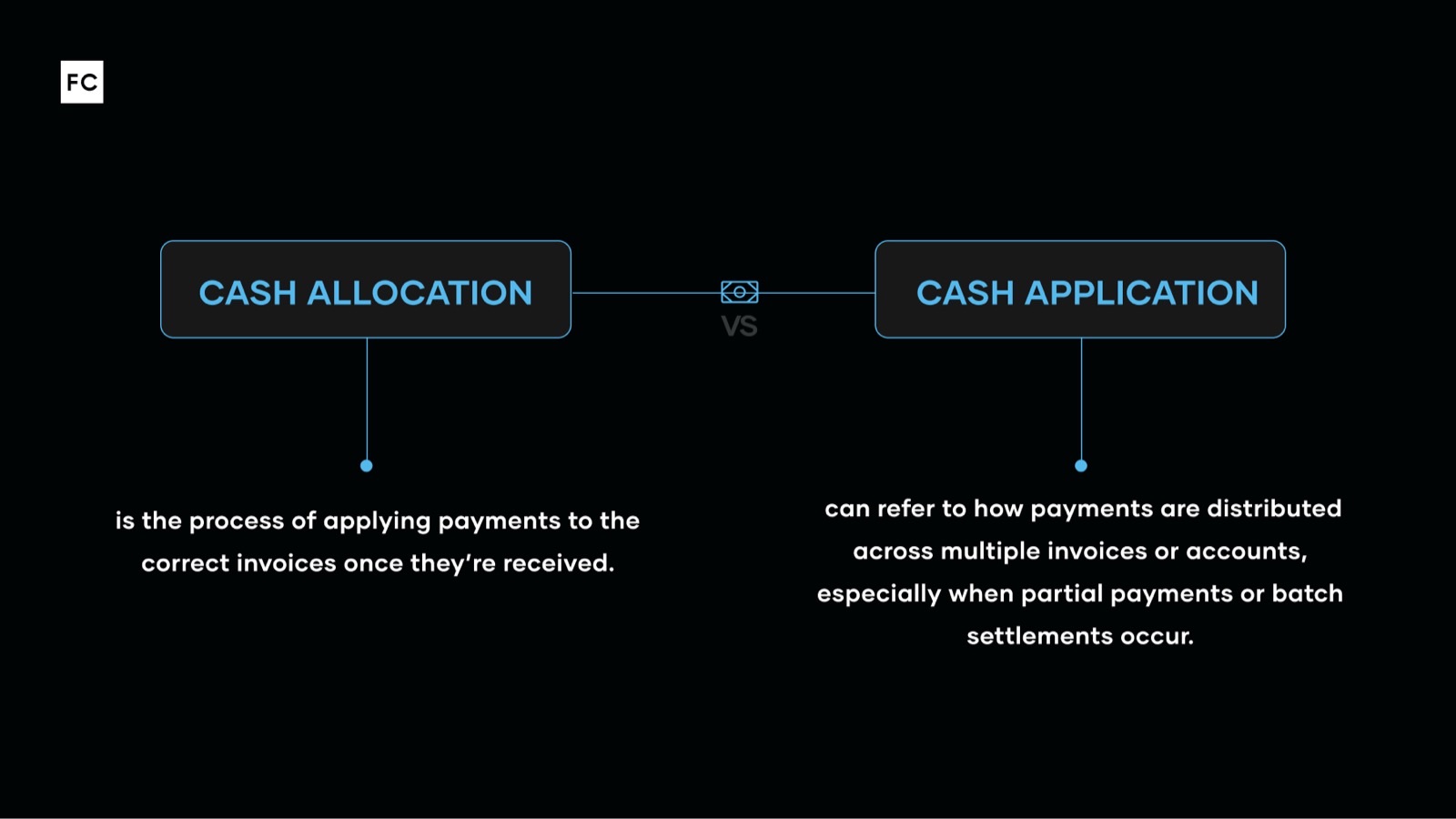
- Cash application is the process of applying payments to the correct invoices once they’re received.
- Cash allocation can refer to how payments are distributed across multiple invoices or accounts, especially when partial payments or batch settlements occur.
FactorCloud handles both automatically. Whether a payment covers one invoice or ten, the system ensures everything is accurately applied and accounted for.
The Cost of Manual Cash Application
Before we get into automation, it’s worth understanding just how much manual cash application costs factoring companies (both in time and money.)
1. Inefficiency
Processing payments manually means factoring staff must:
- Download remittance files from banks or lockboxes
- Parse invoices line by line
- Manually enter data into spreadsheets or software
- Double-check accuracy before closing the books
Even for small firms, this can consume hours every day. For large factors managing hundreds of clients, the workload can feel endless.
2. Human Error
Manual data entry inevitably introduces risk:
- A single digit out of place can misapply a payment.
- Missing or inconsistent remittance info can delay reconciliation.
- Duplicate entries can distort client balances.
These errors ripple downstream and can slow funding, trigger reconciliation headaches, and frustrate clients.
3. Delayed Reporting
When payments aren’t applied quickly, financial data lags behind reality. Factoring managers may think accounts are unpaid when they’ve actually cleared, or vice versa. This delay impacts:
- Funding decisions
- Credit analysis
- Collections follow-ups
- Client reporting
In short: Manual cash application slows down everything that makes factoring profitable.
How Automatic Cash Application Works
The good news? Modern technology can automate almost every step of the factoring process.
Automatic cash application uses AI, optical character recognition (OCR), and configurable business rules to match payments to invoices without manual intervention.
Here’s how it works in practice:
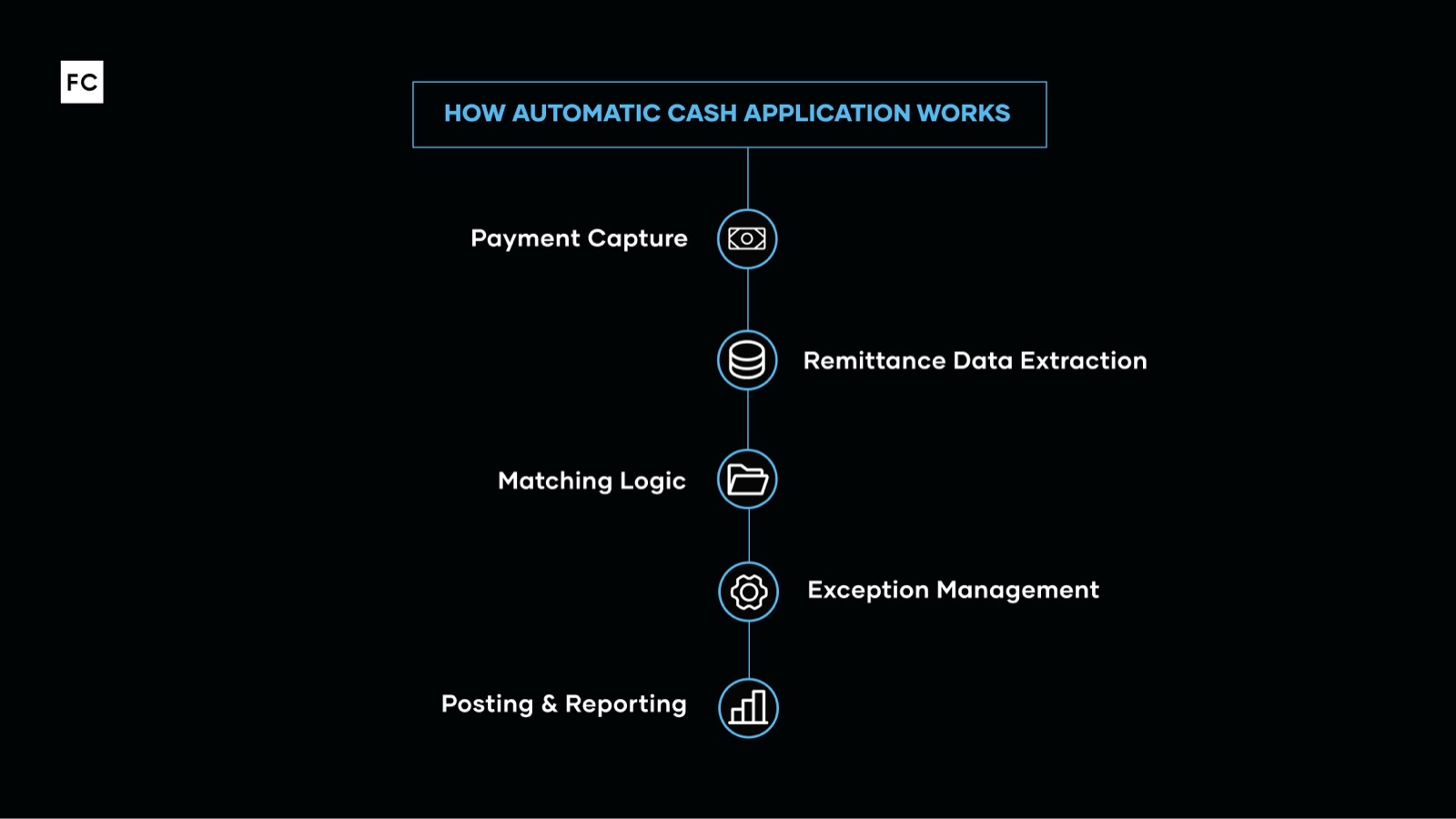
1. Payment Capture
The system ingests payment data from multiple sources, including:
- Bank deposits
- ACH transfers
- Wire payments
- Lockbox or remittance files
- Email attachments or uploaded statements
Every payment is imported into one centralized system, so there’s no need to pull data manually from multiple places.
2. Remittance Data Extraction
Using OCR and smart document parsing, the platform reads remittance advice, PDFs, and scanned documents to identify key details such as:
- Invoice numbers
- Payment amounts
- Customer names or account numbers
- Payment dates
These details are automatically mapped to corresponding invoices in your factoring ledger.
3. Matching Logic
The system applies built-in matching rules to connect each payment with the right invoice or batch of invoices. For example:
- One-to-one (single payment to single invoice)
- One-to-many (single payment covering multiple invoices)
- Many-to-one (multiple partial payments for one invoice)
If there’s a discrepancy, such as a short pay or overpayment, the system flags it for review rather than halting the entire process.
4. Exception Management
Exceptions are automatically categorized and escalated:
- Short pays can be routed for review.
- Unidentified payments are logged for quick follow-up.
- Overpayments can trigger credit balance notifications.
Instead of manually tracking down these cases, your team simply resolves exceptions inside a single dashboard.
5. Posting & Reporting
Once payments are applied, the system updates all relevant ledgers instantly, ensuring that your factoring data, client reports, and cash positions are always current.
The result? Cash flow visibility in real time, fewer manual touchpoints, and more time for high-value work.
Why Cash Application Matters for Factoring Companies
Automating cash allocation isn’t just an efficiency play; it fundamentally improves your business model. Here’s why:
- Faster funding cycles: The sooner payments are matched and applied, the faster funds can be released to clients.
- Improved accuracy: Automation eliminates the inconsistencies that come from manual data entry and varying remittance formats.
- Better client experience: When clients can see their invoices paid and posted accurately—without delays or confusion—confidence grows.
- Reduced overhead: Manual reconciliation is labor-intensive. Automating cash application reduces that workload dramatically, freeing your staff for other tasks and initiatives.
- Smarter decision-making: With real-time data and up-to-date ledgers, factoring companies gain a clearer view of cash positions, outstanding debts, and credit exposure.
How FactorCloud Automates Cash Application
While many systems can automate AR workflows, few are built specifically for factoring. That’s where FactorCloud stands apart.
FactorCloud integrates cash application and allocation directly into the factoring lifecycle, from invoice submission to payment reconciliation, all in one secure, cloud-based platform.
Here’s how FactorCloud handles it:
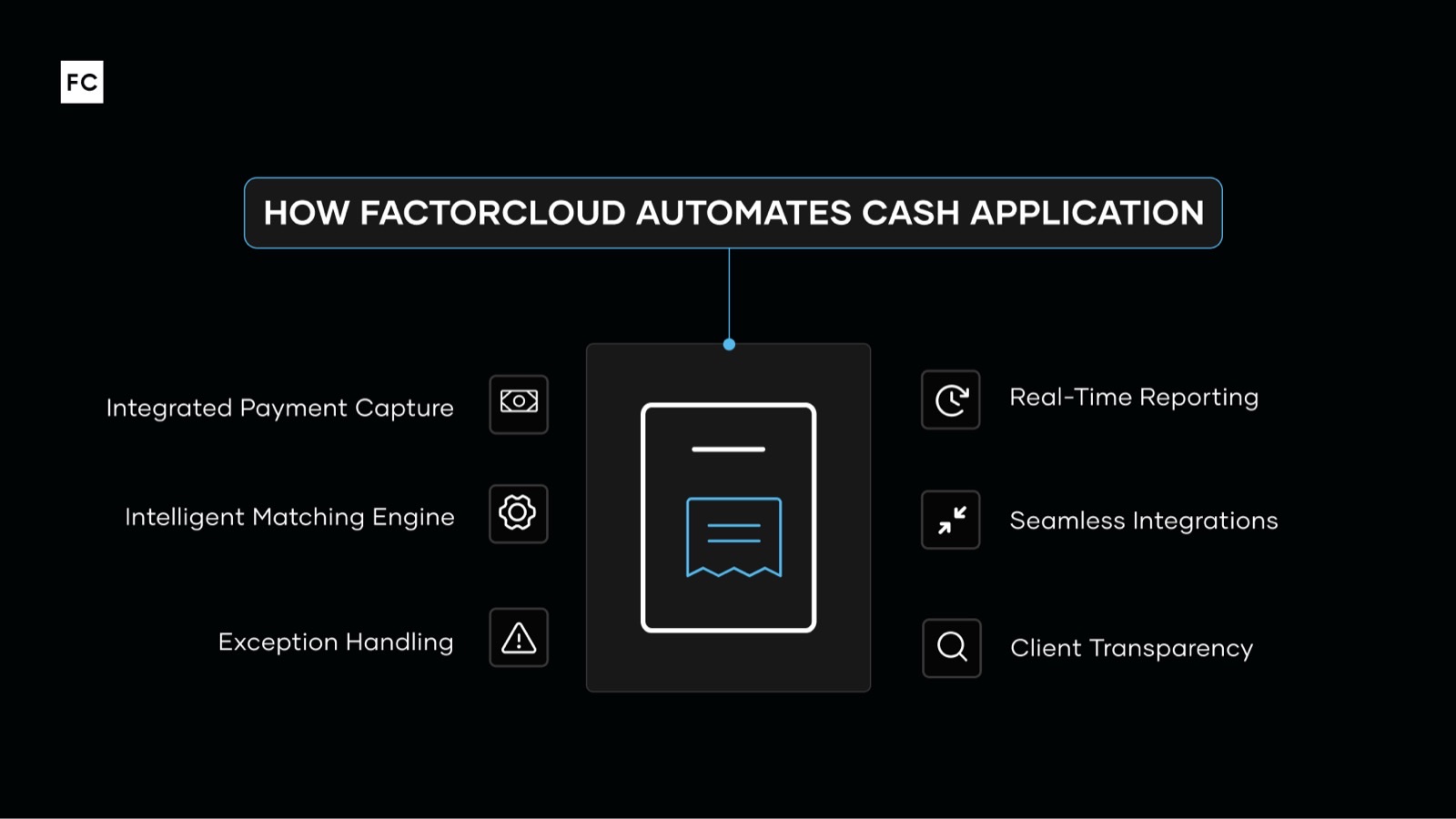
Integrated Payment Capture
Payments from debtors are automatically imported into the FactorCloud system, whether they come from bank feeds, lockboxes, or manual uploads.
No external tools or duplicate entries required.
Intelligent Matching Engine
FactorCloud uses configurable rules to automatically connect payments with the right invoices or schedules. It understands factoring-specific nuances like batch schedules, split payments, and debtor-client relationships, so you’re not trying to retrofit a generic AR tool.
Exception Handling
Instead of leaving your team to chase errors, FactorCloud highlights exceptions in a single dashboard.
You can easily review short pays, unapplied cash, or duplicate entries and resolve them in seconds.
Real-Time Reporting
Every applied payment updates your factoring reports immediately, giving you an always-accurate picture of cash flow, funding availability, and client balances.
Seamless Integrations
FactorCloud’s open API connects to your existing banking, credit, and accounting systems for smooth data flow and minimal manual input.
Client Transparency
Clients can view payment status directly through their FactorCloud portal, reducing inbound questions and support tickets.
The ROI of Automating Cash Application
The benefits of automating cash application go far beyond saving time:
- Reduction in unapplied cash
- Faster payment processing
- Significant labor savings, allowing teams to reallocate their time to higher-value work
For factoring companies, those gains directly translate to:
- Faster turnaround between funding and collection
- More accurate portfolio reporting
- Lower operational costs per client
- A stronger competitive edge through speed and reliability
And because FactorCloud integrates cash application with all other factoring operations—credit, collections, reporting, and client management—the ROI compounds across your entire workflow.
Implementing Automatic Cash Application in Your Workflow
If your factoring company still relies on manual matching or standalone AR tools, transitioning to automation can seem daunting.
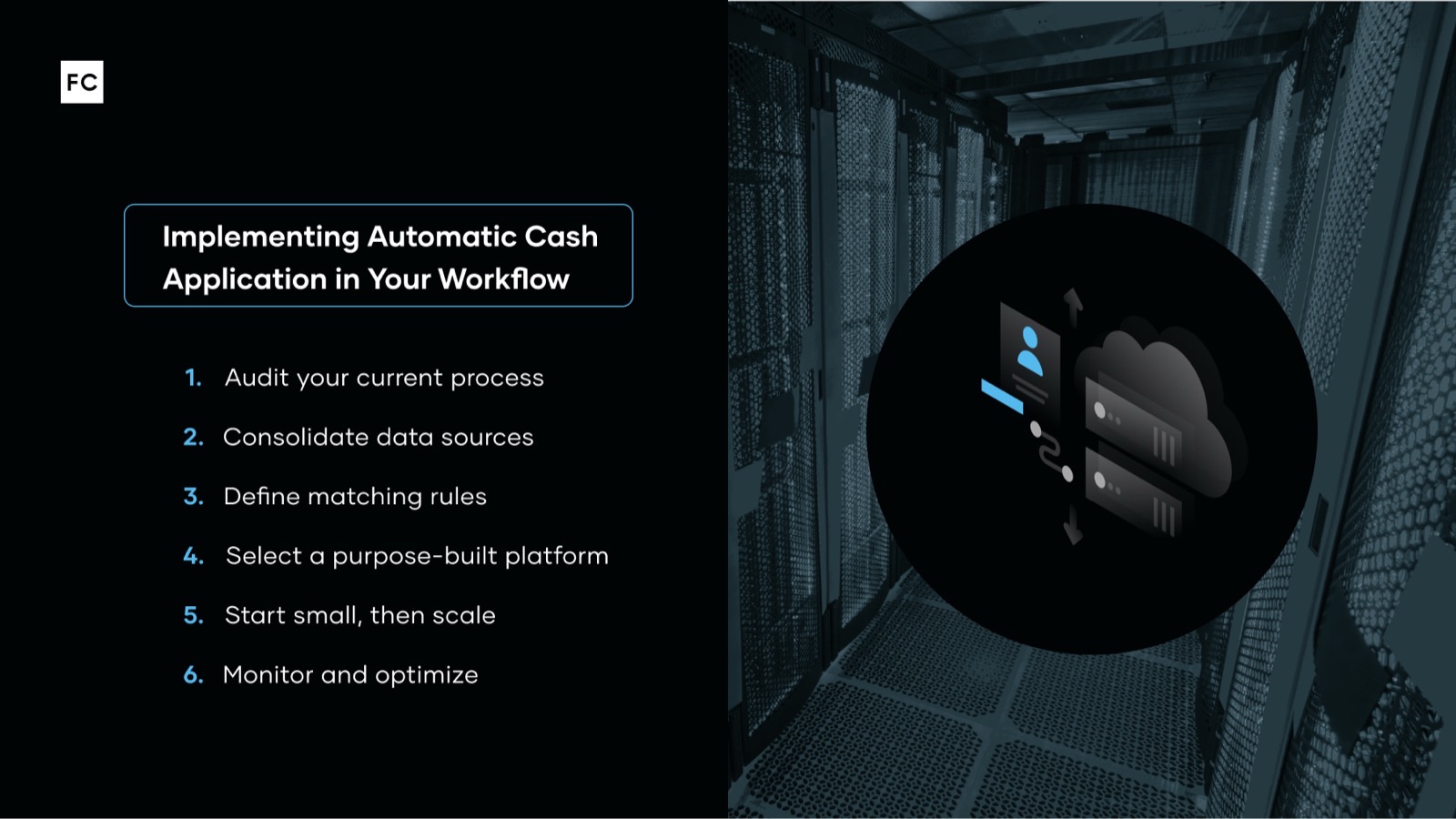
Here’s how to approach it step by step:
- Audit your current process: Identify where delays or errors most often occur.
- Consolidate data sources: Gather all payment inputs (bank files, lockboxes, client portals) into one centralized stream.
- Define matching rules: Determine the logic your system should follow: invoice number priority, tolerance thresholds, rounding, etc.
- Select a purpose-built platform: Choose a system like FactorCloud that supports factoring-specific logic, integrations, and reporting.
- Start small, then scale: Automate one segment first (e.g., top clients or a single payment channel), then expand as you refine the process.
- Monitor and optimize: Track metrics like match rate, unapplied cash, and processing time. Continuous improvement will maximize ROI.
Why Automation Is No Longer Optional
In 2025 and beyond, manual payment processing simply doesn’t scale.
Factoring companies face higher transaction volumes, more complex client portfolios, and growing expectations for speed and transparency.
Automatic cash application turns a painful, error-prone process into a seamless part of your daily operations.
With FactorCloud, you don’t need multiple systems or workarounds. You get a unified, cloud-based platform designed to handle everything from invoice upload to payment reconciliation, all with factoring-specific precision.
See FactorCloud’s Cash Application in Action
If your team still spends hours manually matching payments, chasing remittances, or reconciling reports, it’s time to simplify.
FactorCloud automates cash application, cash allocation, and every other key step in the factoring process, helping you scale faster, reduce errors, and keep clients happy.
Schedule a demo to see how automatic cash application works inside FactorCloud.